Before you add more ad budget, check what’s happening to the traffic you already have

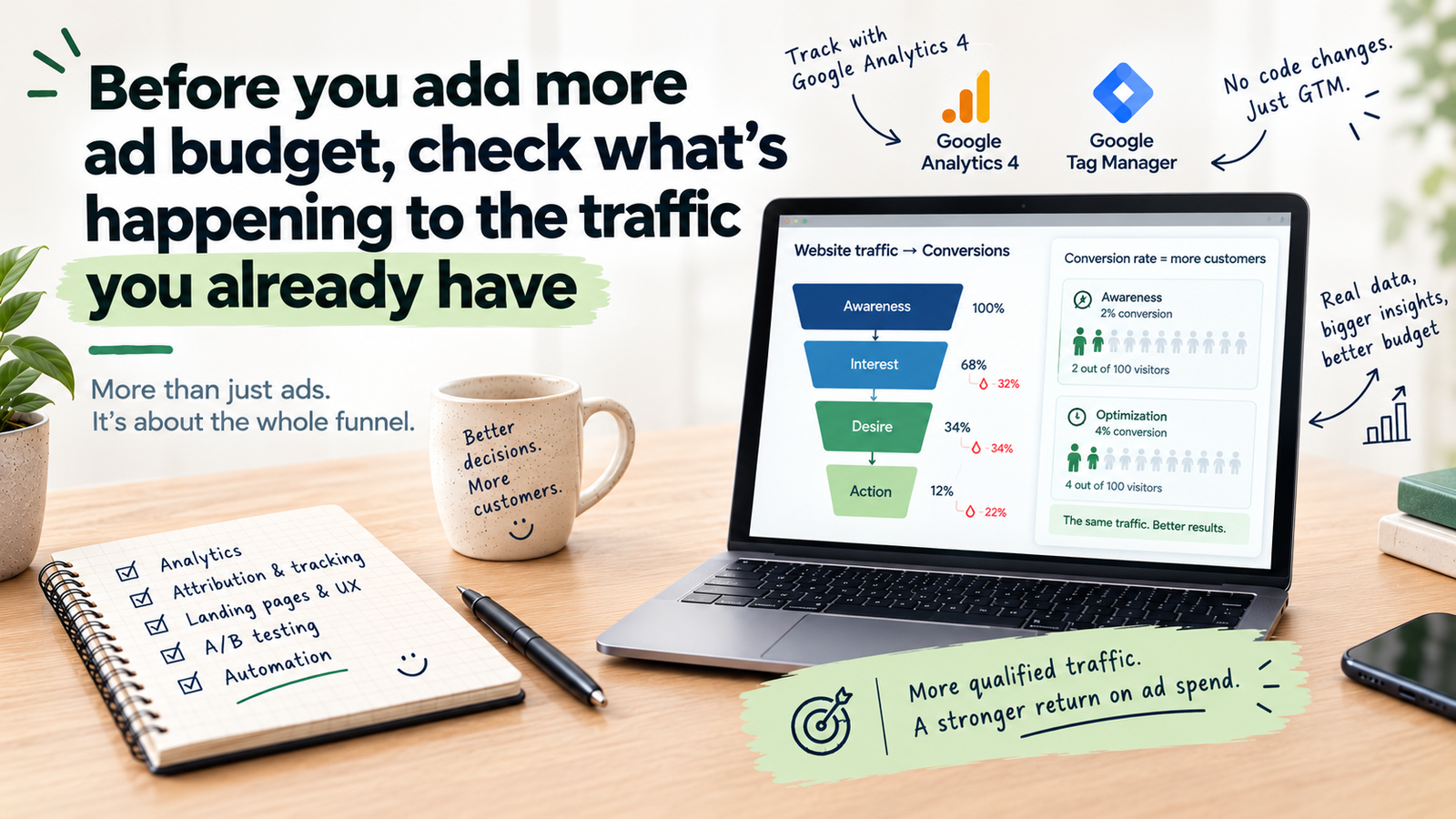
As an online marketing specialist, I often hear the same sentence: “Sales are too low, we need to increase the budget.” Sometimes that really is the right call. Quite often, though, the problem lies elsewhere: valuable traffic is there, but it gets lost somewhere along the way.
Imagine a pipe with a few, or many, invisible leaks. You can increase the pressure at the inlet, but you will still get less at the other end than you put in. A sales funnel works the same way. Advertising is the tap that fills it, but the number of leaks decides how much actually makes it to the end.
I'm not writing this against advertising, because without traffic there is often nothing to optimize. It is about order, and about treating these two things as one system rather than two separate projects.
Two types of funnel losses, and the apparent leak
Not every lost user is the result of a mistake.
Natural losses. Someone was looking for information, not a product. Someone is comparing offers a year before buying. Someone clicked out of curiosity. You can't “win back” these people, and there is nothing wrong with that. All you can do is make sure the funnel attracts more people who fit your offer.
Unnecessary losses. These are customers who were interested, but something got in their way. A form that doesn't work well on mobile. A page that loads slowly. A price that can't be found. An inquiry email that nobody answered for three days. These are the places worth looking for, because fixing them often costs far less than acquiring new traffic.
The apparent leak. I often come across the expectation that a campaign should bring in sales in a simple proportion: I put in a zloty on ads, and it immediately comes back as profit. When the effect doesn't show up right away, the conclusion is sometimes that the campaign doesn't work. Yet the path from first contact to purchase is usually longer and more convoluted than it seems.
A user visits the site, reads, comes back later, and, especially with more expensive or more complex products and services, doesn't decide right away. Often one channel opens the way to the brand while a completely different one closes it, and this happens after a longer time or after many touchpoints. So before you decide there is a hole in your funnel, check whether it is simply the time the customer needs to make a decision.
There is one condition: the brand has to look professional at every stage, so that the customer's belief that buying is a good idea doesn't fade along the way. An apparent leak very easily turns into a real one if the customer returns to the site and runs into a slow form, no response, an unclear offer, or a lack of confirmation from satisfied customers.
Four stages: the AIDA model in practice
To organize problems I use the AIDA model: Attention, Interest, Desire, Action. It is a considerable simplification, but a useful one, because it lets you assign a problem to a specific stage and avoid looking for a solution in the wrong place. It is worth remembering that every stage concerns not only the website, but the whole company: the offer, the sales team, customer service, and communication.
Two practical things follow from this division into stages. First, at each stage, different metrics tell you about effectiveness (or the lack of it). The same result that is a good signal at one stage may mean nothing at another. A high number of visits shows that you are reaching people, but it says nothing about whether those people get what they are looking for. That's why looking at a single number, such as the final conversion rate, is not enough to find the cause of a problem.
Second, what matters to a potential customer is different at each stage. At the beginning, what counts is whether the message is relevant and credible to them. A moment later, whether the page is clear and fast. When they start comparing, they need specifics: prices, reviews, information about delivery times, a clear offer. At the end, what matters is simplicity and the sense that they know what will happen after they click or make a call. Improving elements that matter at a different stage than the one where people actually drop off is a common reason why optimization brings no results.
1. Attention: am I reaching the right people?
This is where everything starts. Lots of clicks but low engagement on the site is a common sign that the ad attracts the wrong people. Keywords, ad copy, and targeting settings all affect this.
The attention stage is not only about paid traffic, though. Visibility in organic results, Google reviews, and presence in the places where customers look for information also count. If the first impression in search results is weak, some people won't even visit the site.
You measure things like traffic sources, ad CTR, the share of new users, and whether traffic from a given source actually engages with the site. Here the customer is looking above all for confirmation that they have come to the right place: a message that matches what they were looking for, and signs of credibility (reviews, the company's visibility).
2. Interest: the first seconds decide
Someone lands on the site, picks up a call from a salesperson, or opens your email. Within seconds they decide whether to stay.
On the website, what matters is loading speed, readability, and whether it is immediately clear what the company does and who it is for. It is also worth checking how the site looks on a phone, especially after arriving from an ad.
This applies to contact outside the website as well. How quickly do you reply to inquiries? Does the first email read like an answer to a specific question, or like a template sent to many people? Who answers the phone, and do they know how to talk to a potential customer?
You measure things like load time, engaged sessions, scrolling, the number of click-throughs to the next page, and, outside the website, the response time to inquiries and the phone answer rate. The customer expects speed, readability on mobile, and for it to be immediately clear what the company does and who it is for.
3. Desire: the customer gathers arguments
The customer already knows the offer may interest them. They compare, read reviews, look for details. At this stage, the winner is often the one who answers questions better, not necessarily the cheapest.
Prices hidden behind a contact form, no reviews in a visible place, no information about lead times, an offer in a PDF from years ago, written in the language of features instead of benefits: all of this lets the competition get ahead of you in the customer's mind. A lot also depends on the sales team here, and on whether they can talk calmly about price and answer typical objections.
You measure things like visits to offer and pricing pages, return visits, downloads of materials, responses to the offers you send, and the number of booked calls. The customer is looking for specifics: price, reviews, offer details, answers to objections, arguments for comparing with the competition.
4. Action: small obstacles, big losses
The last step is a form, a phone call, an order button, signing a contract. It concerns people who are already close to a decision, so even a small obstacle hurts the most here.
A form with ten required fields, no phone number, five steps in the cart instead of two, no preferred payment method: any of these can stop a person who was ready to buy. The shorter the path from decision to contact, the better.
It is also worth looking at what happens after the sale. A satisfied customer who returns or recommends the company to others is traffic at the top of the funnel with no advertising cost.
You measure things like the conversion rate, the difference between started and submitted forms, abandoned carts, the time from inquiry to first contact, and how many inquiries end in a sale. The customer needs simplicity: a short form, convenient payment, a clear next step, and a sense of security.
A simple calculation that changes perspective
Suppose that out of every hundred people on the site, two make a purchase. The conversion rate is 2%. If you double your ad budget, in theory you will double traffic and sales, but also costs. The effect is proportional, just more expensive.
In practice it is often even worse. Increasing the budget often means your ads reach a wider, less well-matched group than before, because the system no longer has enough “most interested” people to serve. Then costs grow faster than sales, and the simple proportion stops working.
If instead you improve the funnel so that four people out of a hundred buy, with the same budget you have twice as many customers. Only then does adding budget start to produce an amplified effect, because every zloty spent on traffic works harder than before.
This is of course just an example, and in practice you can't always achieve such a result, but it shows why it is worth starting by checking the funnel.
How to find the places where your funnel leaks
Start with the numbers. How many people visit the site? How many move on to the offer? How many reach the form? How many send an inquiry? How many inquiries turn into a conversation, and how many conversations end in a purchase? Wherever the drop between consecutive stages is unexpectedly large, it is worth looking for the cause.
A few methods that help:
- Analytics. Google Analytics or another analytics tool shows how users move around the site and at which point they leave it. For this data to be reliable, tracking has to be implemented properly, for example through Google Tag Manager, so that you track clicks, submitted forms, and key steps of the path, not just page views.
- Session recordings. They show where people click, where they get lost, and where they stop scrolling. This often uncovers problems that aren't visible in the numbers alone.
- Conversations with customers. Ask people who had contact with the company but didn't buy what made the difference. Done simply and without sales pressure, this often gives the best answers.
- Conversations with salespeople. These are the people who hear every day from customers what they like and what puts them off. Ask them why, in their view, customers choose the company and why they leave, which objections come up most often, and which questions have no good answer. It is also worth checking whether the salespeople even know why the brand performs poorly or well. If they don't, that is important information in itself. Sealing the funnel is not only about fixing weaknesses, but also about strengthening strengths: what customers value should be shown more clearly and earlier, and what puts them off needs to be worked on.
- Looking through the user's eyes at every stage. For each stage of the funnel, ask yourself: what might this person be missing in order to move on? At the attention stage it may be a clear message and credibility. At the interest stage, a fast, readable page. At the desire stage, specific information, reviews, and answers to concerns. At the action stage, a simple process and certainty about what happens next. The missing element is often exactly the hole you are looking for.
- Testing your own path. Visit your site from your phone via an ad. Send an inquiry as a customer would. Call the company. See how long it takes to get a response and what the offer you receive looks like. It is quick and surprisingly effective.
- Automating inquiry handling. Some unnecessary losses result from delays, for example when an inquiry from a form lands in an inbox and sits there for several hours. Simple automations, for instance in Make.com, can pass inquiries immediately to the right person or to a CRM.
- Looking at the competition. The market doesn't stand still. The fact that the company performed well a year ago doesn't mean it performs the same today, because competitors may have improved their offer, service, or the way they present their strengths in the meantime. Then what used to be a strong argument stops standing out, and results drop even though nothing has changed on your side. Regularly visit competitors' sites through a customer's eyes: compare prices, offers, reviews, response times, and how they present their advantages. Also check how you look next to them in ads and search results. This will show you which of your strengths still hold up and which need to be presented better or built anew.
This is not a task to tick off
Sealing the funnel never ends. Customers change, the market changes, and what worked a year ago may no longer make an impression today. A company that regularly reviews its sales path and looks for places to improve has an advantage over one that does it once every few years, or never.
What the company can do, and where I can help
A large part of sealing the funnel has to happen inside the company. Conversations with salespeople, the quality of the offer, response speed, the way customers are served, and work on how the company compares to its competitors are things that only the company itself knows and can change. There are, however, areas where I can really help:
- Implementing analytics. I will set up tracking that shows various interactions with the site: clicks, submitted forms, key steps of the path. That way, instead of guessing, you will see at which stage people drop off.
- Automation. I will automate many website functions and the flow of information in the company, for example passing inquiries to the right people, notifications, or organizing data about inquiries, so that nothing sits and waits for manual handling.
- Website elements. I will add solutions to the site that build the company's credibility at the individual stages of the funnel, highlight its strengths, or collect leads, that is, ones that help the customer move on to the next step.
- Website audit. I will review the site with an expert's eye and point out its weak spots from my point of view: places that may discourage visitors, lose customers, or weaken the message.
If you are wondering whether the problem is the traffic or what happens to it after the click, get in touch. We will start by checking what is actually happening to the traffic you already have, and decide which elements are worth improving first.
About the Author: Jakub Ruciński
Deploying enterprise-grade GA4 pipelines, GTM DataLayers, and automated lead nurturing systems using Make.com and Positive User (formerly User.com).
Consult Your Architecture