
How to Sell a Product That Takes a Long Time to Decide On

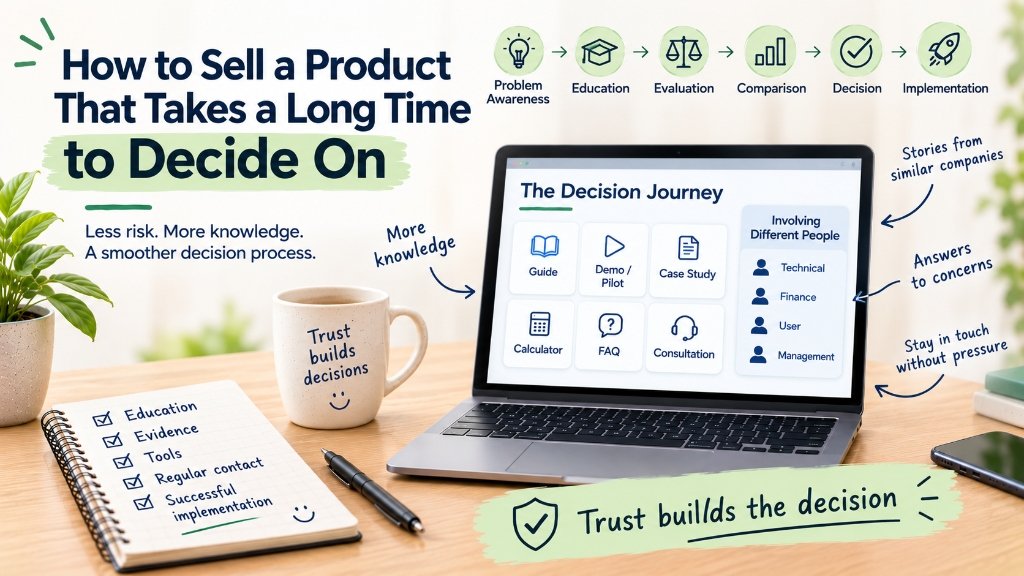
Some offers speak for themselves: a good photo, a fair price, a “Buy Now” button, and that is it. Others have no such shortcut. Specialized machinery, industry software, services for a narrow group of companies, or implementations expensive enough to require agreement among several people. Marketing such products follows different rules than selling everyday goods.
There are few buyers, so every inquiry matters. The decision takes a long time, sometimes over a year. On the client’s side, several people usually sit at the table, and each evaluates the offer differently. A mistake costs not only money, but also the credibility of the person responsible for the purchase.
So the point is not to rush the customer. A better approach is to help them think: give them the knowledge, tools, and sense of security they need to reach a conclusion on their own. Below are eight ways to do this. You do not need to introduce all of them at once, because each removes a different obstacle on the way to a decision. With each one, I add how this works on the website and conversion side, because that is where these ideas are easiest to turn into concrete action.
1. Teach First, Make an Offer Later
Someone buying a solution for the first time often does not know what to ask suppliers. They do not know the evaluation criteria and cannot tell which parameters truly matter and which only look good in a catalog. That uncertainty is often a bigger barrier than price.
A company that helps clear it up earns the position of a trustworthy partner. Good content answers questions from the very start of the journey: how to evaluate a solution of this type, what to look for when comparing offers, what mistakes beginners make, and where the typical implementation traps lie.
Tone is what matters most. A guide that praises your own product in every paragraph is easy to see through. Material that openly explains when a given solution is a good choice and when it is not builds trust, even if it sometimes points to another option. A customer who was guided honestly remembers that at the next opportunity.
Showing the full map of the buying process, from recognizing the problem to implementation, also works well. Someone who can see which stage they are at and what awaits them next feels less confusion, and the company becomes a guide rather than a seller waiting for a signature.
From a CRO perspective: It is worth connecting such a guide to a specific step, for example downloading a checklist in exchange for an email address. That way, a reader who is not ready for a conversation yet leaves their contact details in a way that costs them nothing.
2. Do Not Make the Decision Look Irreversible
The higher the stakes, the stronger the fear of making a mistake. The customer worries that the implementation will fail, the product will not meet expectations, or it will turn out not to fit what the company already has. Fear of making a mistake often outweighs the desire for benefits, which is why many decisions are put off and eventually forgotten.
Breaking the decision into smaller steps helps: a trial period, a demo version, a pilot in one department, or a limited purchase with the option to expand later. Each of these forms makes it possible to take the first step without feeling that the door is locking behind you.
Clear terms are equally important. What happens if the implementation is delayed? What if the product does not reach the agreed parameters? What does cancellation look like? A customer who knows the answers before signing the contract feels much safer. An open conversation about what can go wrong usually builds trust, because a supplier who talks only about successes seems suspiciously perfect.
It is also worth describing how the company behaves in difficult moments. Every major project runs into problems, and the customer knows this well. A supplier who calmly explains what complications are typical and how they are solved signals real experience. That often weighs more than differences in technical specifications.
From a CRO perspective: Instead of a single “Contact Us” button, give visitors several entry points requiring different levels of commitment: a demo version, a short consultation, a free audit. The smaller the first step, the easier it is to take.
3. Stories of Companies Similar to the Customer
Reviews from other users are among the strongest decision factors, but only when they are relevant. A general comment like “Great cooperation, highly recommended” says very little to someone wondering whether the product will work in their situation.
A story about a company from the same industry, of a similar scale, and with similar problems works much better. A case study that describes the starting point, the decisions made, what worked, and what needed fixing allows the reader to see themselves in someone else’s story. Accounts that do not hide difficulties are especially valuable. A version without a single flaw makes people skeptical, whereas one that includes problems and how they were solved builds trust.
Sometimes a simple list of companies using the solution is enough. In a narrow industry, familiar names act as a signal that the product has passed the test with demanding users.
The strongest form is a reference call: the chance to ask questions directly to someone who already has the implementation behind them. This requires trust in your own clients and your own product, but it gives what no promotional material can replace, an unfiltered answer. It is also worth keeping such stories up to date, because a case study from years ago describing a version of the product that no longer exists can do harm.
From a CRO perspective: Customer stories should not sit in a separate tab that nobody visits. It is better to place them right where doubts appear: next to the form, by the price list, or on a specific service page.
4. Self-Assessment Tools
Buyers often prefer to check on their own first whether there is even anything to talk about. Contacting a salesperson means commitment and the fear of being pushed. A well-designed online tool makes it possible to assess the fit without that pressure.
This could be a calculator showing approximate cost or savings, a configurator guiding the user through parameter selection, a short quiz assessing the company’s readiness for implementation, or a checklist showing what needs to be prepared before talking to suppliers.
The benefit goes both ways. The customer gets an answer on whether the solution is for them without involving anyone. The company hears from someone who knows what they are asking about and has already done an initial evaluation. The conversation starts with specifics, not from zero.
Honesty in the results is key. A calculator that always shows the purchase pays off is quickly dismissed as a trick. A tool that in certain situations honestly suggests the solution is not the best fit strengthens the credibility of the whole company. Results should be presented as estimates rather than promises.
From a CRO perspective: A qualifying quiz is one of the mechanisms you can add to a website without rebuilding the entire site. The user’s answers let you immediately show content matched to their situation, while giving the sales team context before the first conversation even starts.
5. Every Decision-Maker Has Their Own Questions
In specialized purchases, one person rarely decides alone. There is an initiator who noticed the problem, an expert evaluating the technical side, someone watching the budget, future users, and the person who signs at the end. The specialist cares about parameters and integrations, finance cares about total cost and return, users care about everyday convenience, and the board cares about risk and alignment with strategy.
A company that talks to only one of these people often loses the moment the discussion moves inside the client’s organization. An enthusiastic contact comes back with questions from people who have never seen the supplier, and there is no one to answer them.
That is why it is worth preparing materials that are easy to pass along: a brief summary for the finance department, documentation for engineers, answers to user concerns, and a single page for the board explaining the reasoning behind the decision. Each document should speak the language of its audience.
A simple question also helps: who else will take part in the decision and what might they need? Your contact rarely thinks about this on their own, yet will gladly answer. There is often a skeptic in the group as well. Usually they are not an enemy; they just want to be sure the matter has been thought through. Treating their doubts seriously can turn them into the strongest defender of the choice.
From a CRO perspective: A website can have separate paths for different roles, for instance a section “For Finance” or “For IT” with downloadable materials. Proper tracking shows which of them someone actually opens, which already tells you who is taking part in the decision.
6. Presence Without Being Pushy
Since the decision takes months, the company has to stay in the customer’s memory the whole time. It is easy to do this poorly: calling too often to ask if a decision has been made wears people out, while complete silence means that after a quarter nobody remembers the supplier.
Staying in touch the right way is about giving value, not reminding people about yourself. A message with new, useful information is completely different from asking for a status update. It can be an article expanding on an earlier thread, news about industry changes affecting the decision, a new case study, or an invitation to an event.
In practice, a set of several elements works well: a regular newsletter with educational content, remarketing that reminds website visitors about the company, and personal messages from a salesperson referring to specific points from earlier conversations. It pays to write down what was discussed and what doubts came up. A meeting after three months that starts with a reminder of what you last agreed on shows attentiveness. One that starts with “How can we help?” forces the customer to repeat everything from the beginning.
Sensing the customer’s work rhythm also helps. Budget planning season or preparations for an important board meeting are good moments for a more concrete conversation. In other months, it is better to leave the prospect in peace.
From a CRO and advertising perspective: Remarketing in Google Ads and other channels works best when the campaign does not repeat the same offer over and over, but guides the recipient through sequential content: a guide, a case study, a tool. This requires well-configured audience lists and tracking, which can also be set up in Google Tag Manager.
7. Answers Before the Questions Are Asked
Every specialized product has a set of concerns that come up with most buyers: the price exceeds the budget, implementation will take too long, the solution will not work with current systems, the company will become dependent on one supplier, or the team will not cope. Some customers ask about this directly, but many stay silent and quietly decide the risk is too high.
The most effective approach is to discuss these issues before the customer raises them. A good FAQ section that does not avoid uncomfortable topics is one of the most valuable parts of a website. It is worth describing honestly how long implementation really takes and what it depends on, what costs appear only after purchase, and what the solution works with and what it does not.
Comparisons are especially useful. A buyer almost always compares an offer with alternatives: other suppliers, an in-house solution, or keeping things as they are. A company that presents such a comparison itself, honestly pointing out the strengths and weaknesses of different options, helps with work the customer will do anyway. It is better for them to base it on reliable data than on random opinions from the web.
Speaking openly about limitations can be difficult because it goes against the sales instinct. Yet it works the opposite way from what you might fear: someone who has heard in which situations a solution is not the best choice will more easily believe what the company says about its advantages. Talking regularly with people who did not buy also helps. After a dozen or so conversations, repeating patterns usually appear that can be turned into website content and sales materials.
From a CRO perspective: The questions customers ask most often are a ready-made list of places where the website should respond. An answer can appear next to the form, in a popup, or in a bar at the top of the page at the moment a doubt usually comes up.
8. Sales Continue After the Contract Is Signed
With specialized products, a signature does not close the process. The first weeks and months after purchase decide whether the customer will be satisfied, recommend the company, and expand cooperation. In narrow industries everyone knows everyone, so referrals are often the main source of new inquiries.
That is why implementation, training, and initial support should be treated as part of sales rather than a separate activity handled by another department. A customer left alone with a difficult product and unclear documentation starts to regret the decision, even if the solution itself is good. A customer who gets a clear plan, knows their account manager, and quickly sees concrete results becomes convinced they chose well.
It is worth reaching the first visible success as quickly as possible. Where full results appear only after a long time, it is good to set earlier, smaller milestones. They keep the client’s team engaged and give arguments to the person who made the decision in front of those who had doubts. A satisfied customer is also material for case studies, references, and conversations with future buyers, so the whole process closes into a loop where good service strengthens future sales.
A Buying Decision Can Be Designed
It is easy to treat selling a specialized product as something a company has no influence over: the customer will either be ready or not. In reality, this process can to a large extent be designed. You can take care of access to knowledge, reduce the sense of risk, show stories of similar companies, provide tools for self-assessment, help convince other decision-makers, stay present over a long period, and answer concerns before they are spoken.
None of these elements works like a button. Rather, they are a set of ingredients that together create an environment favorable to a decision and reinforce one another. Educational content raises the value of self-assessment tools, good case studies make conversations with multiple decision-makers easier, and openness about limitations makes promises made elsewhere credible.
It is worth starting with one question: where does the customer most often stop, and why? Sometimes it is a lack of knowledge, sometimes fear of risk, sometimes the need to convince colleagues, and sometimes too little contact during a long waiting period. Each of these barriers has its own solution, and simply naming it is half the way to removing it.
What matters most is the approach. On the other side sits a person who is making a serious decision, has doubts, and needs time. A company that can respect that instead of rushing them gains more than a single sale: it builds a reputation as someone worth talking to, even if the decision will not be made for another year.
How to Put This to Work on Your Website Without Rebuilding It
Most of the website elements described above (a qualifying quiz, a checklist download placed inside an article, a multi-variant popup with different commitment thresholds, or an info bar at the top of the page) do not require building the site from scratch or long development work. I implement such solutions directly through Google Tag Manager, complete with full tracking in GA4 and advertising systems.
On my projects page, I have prepared an interactive demo of these mechanisms that you can test yourself:
CRO Mechanisms Implemented via Google Tag Manager
If you want to check which of them would help remove decision barriers for your customers, get in touch.
About the Author: Jakub Ruciński
Deploying enterprise-grade GA4 pipelines, GTM DataLayers, and automated lead nurturing systems using Make.com and Positive User (formerly User.com).
Consult Your Architecture